The Differences Between Thailand’s Long Term Resident Visa and the Thailand Elite Visa

Thailand introduced the Long Term Resident Visa in 2022 with the aim of stimulating the economy and investment by attracting “high potential” foreigners to Thailand. Applications for LTR Visas are administered by The Board of Investment. In comparison, the Thailand Elite Visa was introduced in 2003 by the Tourism Authority of Thailand with the aim to attract affluent visitors, businessmen, investors, and expats to stay in Thailand long-term. Applications for the Thailand Elite Visa are handled directly by Thailand Elite themselves, or via designated agencies such as Thai law firms.

The application process for the Thailand Elite Visa is simpler than it is for the LTR visa, and consequently some applicants for the LTR Visa end-up opting for the Thailand Elite Visa instead. Both visas provide long-stay options for foreigners to remain in Thailand, with one difference being that the Thailand Elite Visa requires a membership fee whereas the LTR Visa does not. Furthermore, the LTR Visa requires proof of income and financial resources and does not come with the same additional benefits that the Thailand Elite Visa provides such as VIP discounts and services.

What categories of foreigners is the LTR Visa aimed at, and what are the advantages over the Thailand Elite Visa?
When launched on September 1st 2022, the LTR Visa aimed to attract one million “high-potential” individuals and their dependants in four main categories; Wealthy Global Citizens, Affluent Retirees, Digital Nomads and Highly Educated Professionals.
In actual fact, many of the initial applicants for the LTR Visa were already resident in Thailand and primarily concerned to change their visa-type. The LTR Visa therefore did not exclusively attract new talent, which is one reason why a large proportion of early applications were rejected.

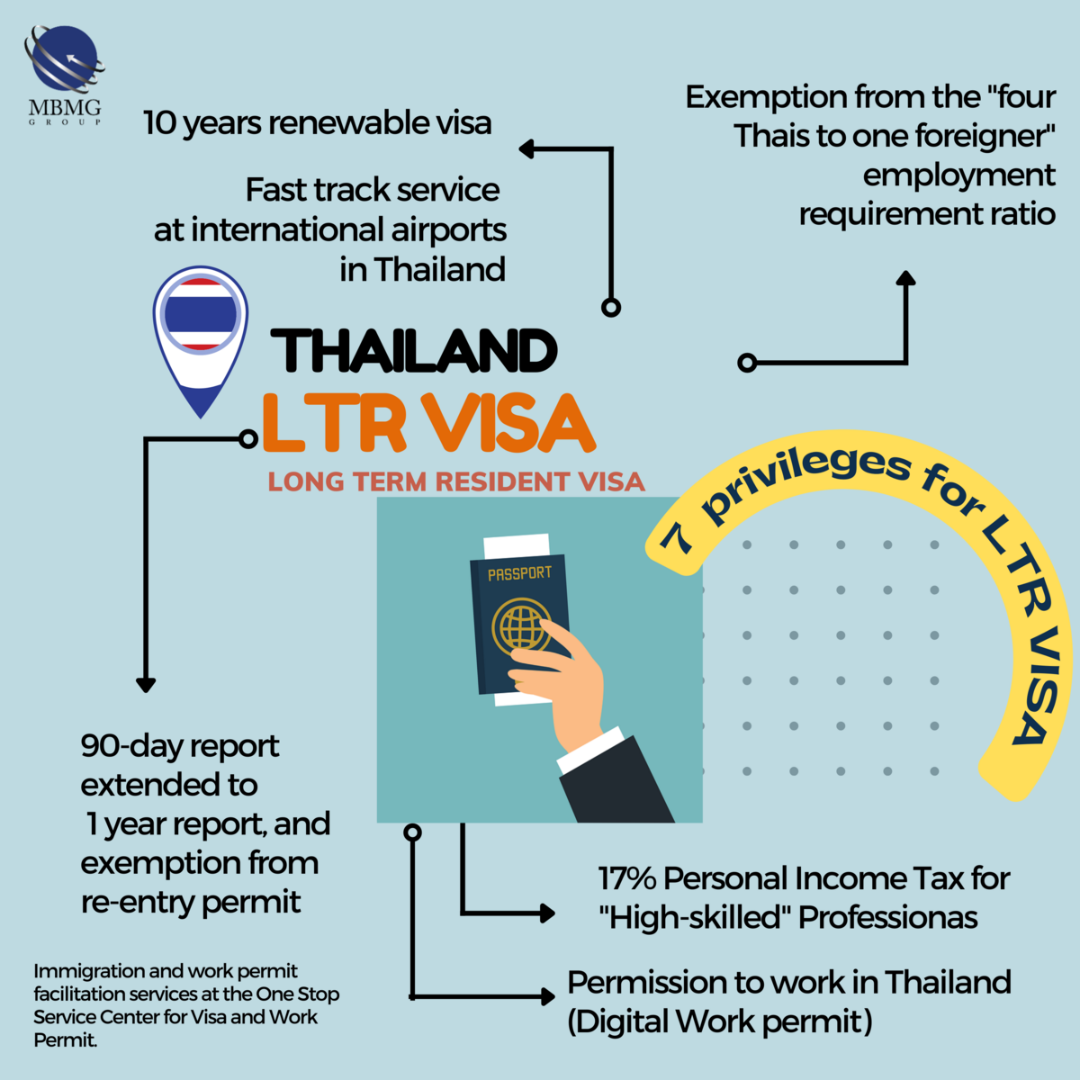
The LTR Visa allows foreigners to remain in Thailand for up to 10 years without the need to reapply, and has an annual reporting requirement rather than every 90 days. More significantly however, the LTR Visa entitles holders to a work permit without fulfilling local employment quotas, exempts overseas income from taxes in Thailand, and caps local personal income tax at 17% rather than the maximum 35% – benefits not provided by the Thailand Elite Visa. Both visas give holders entitlement to ‘Fast Track’ services at Thailand’s international airports and multiple entry rights.
*Infographic courtesy of MBMG Group*
What are the requirements for an LTR Visa?
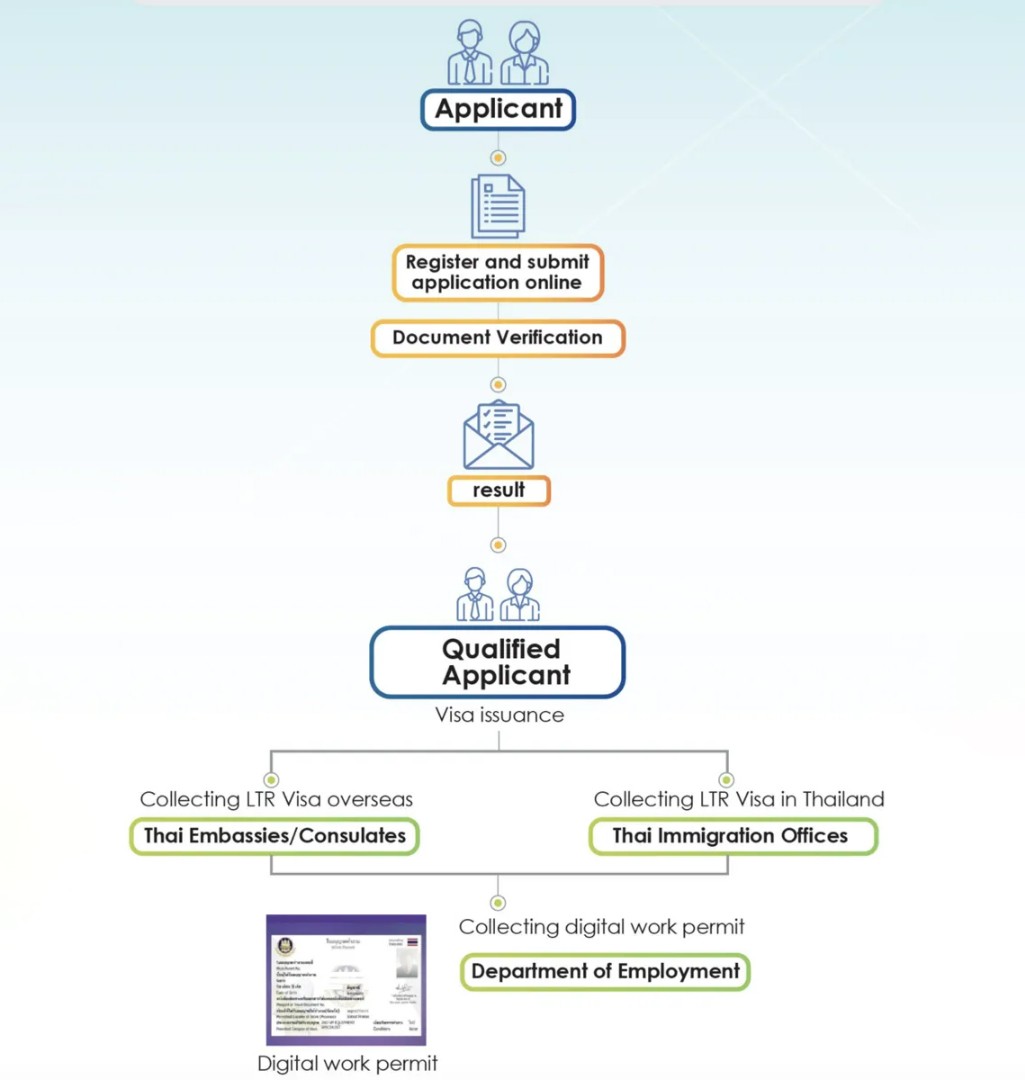
Rather than the relatively high membership fee requirement for a Thailand Elite Visa, the cost for a LTR Visa is THB 20,000, or USD 550. It also covers up to 4 dependents. Headline qualifications for an LTR Visa are proof of an annual salary of at least USD 80,000 for each of the last 2 years, possess at least a master’s degree, have established series A financing for a project, or have demonstrable intellectual property rights if personal income falls below the minimum annual salary.
Requirements applying to the applicant’s employer are that it must be a publicly traded company with at least USD 150 million in sales for each of the last 3 years. Applicants must demonstrate proof of at least 5 years of employment and have health insurance worth a minimum of USD 50,000.
The benefits of the Thailand Elite Visa
The Thailand Elite Visa, although more expensive than the LTR Visa, with a 5-year membership fee starting at THB 900,000 or USD 25,000, requires far fewer qualifications other than no criminal record or record of bankruptcy, and provides multiple privileges. The Thailand Elite Visa is also more wide ranging in terms of its duration (there are a number of options ranging from 5 to 20 years) and also in the services it provides including a 24/7 customer service call centre to help organise everything from Thai bank accounts to a Thai driver’s licence and general support including taking care of the Immigration Department’s requirement for 90-day report-ins. Unlike the LTR Visa, eligibility for the Thailand’s Elite Visa does not require health insurance.

Which type of visa should you apply for?
The answer to this is, of course, all down to personal circumstances. However, although more expensive by some margin, and without the tax advantages of the LTR Visa, the Thailand Elite Visa is easier to apply for and offers several privileges over the LTR Visa. The vast majority of foreigners residing in Thailand however, do so under alternative visas, including retirement, spouse, dependant and employment visas which require annual renewal and regular reporting but are considerably less expensive.

SEND INQUIRY
You have requested more infomation about this property
or Call Richmont's between 9am and 6pm, 7 days a week, on: +66 (0)62 496 6454
Or contact us via WhatsApp or LINE